

Presence Report - Week 12
The first presence report of how I'm solving presence as an engineering problem.

The Screenless Dad was launched for two things:
A field journal of my attempts at solving presence as an engineering problem.
An accountability platform for its impact on me.
The first problem is measuring presence beyond screen time. The second if figuring out how to report these regularly on this blog.
Presense as a Robotics Problem
I treat presence as a robotics problem. Let’s assume you have a robot that’s really easily distractable, has poor self-control and is addicted to instant gratification. This prevents the robot from carrying out its primary function. In fact, the robot’s focus and presence is directly proportionate to its utility.
As an engineer I would need three things to maximize the robot’s presence:
Sensors that capture the right data to catch moments when the robot drifts
Actuators that allow me to course correct
Controllers that can initiate the right course correction from the sensory data
My presence sensors
I track the following (for now):
Screentime via RescueTime
Slack messages (mainly my conversations with Alfred which is 80% of my workday right now)
Meeting transcripts via Zoom
Ambient recordings via Omi
Health data via WHOOP
Commitments via Calendar
It’s not the full picture but a good foundation.
Screen time, Calendar and Slack gives a good pulse on when I’m active and when I’m not. Rescue Time also categorizes the apps and sites I visit which helps a lot. If I’m sending a lot of Slack messages to Alfred outside of my working hours, that’s a sign that I’m drifting.
Another main component is Omi:
When I’m at home, it automatically records everything around me. So if I’m in the living room next to Hanna, Omi will pick up her babble. So if at the same time I’m messaging Alfred on Slack and it’s in the afternoon…again, I’m drifting.
Controlling Presence
Now that I have all the sensors in place, I need a way to control this. For this I built a Presence Tracker, here’s the repo:
https://github.com/ssdavidai/presence-tracker
The Presence Tracker is a very opinionated tracking system that I’m experimenting with that tries to make sense of all the data the sensors pick up.
My goal is to have something like WHOOP’s Strain metric but for my mind. It breaks every day into 15 minute chunks and analyses the sensory data across 7 different metrics:
Cognitive Load Score → How mentally demanding was this window? Driven by meetings, Slack volume, RescueTime app switches, and calendar density
Focus Depth Index → How deep and uninterrupted was myfocus? Penalised by context switching, rewarded by long uninterrupted active periods
Social Drain Index → How much social energy was spent? Meetings with multiple attendees, high Slack send volume
Context Switch Cost → Fragmentation penalty. App switches from RescueTime + multi-channel Slack + back-to-back meetings
Recovery Alignment Score → Is my workload appropriate for my physiology today? Compares CLS against WHOOP recovery using a smooth tanh curve
Daily Presence Score → "How was my cognitive day overall?" — the mental equivalent of WHOOP strain
Cognitive Debt Index → "Am I accumulating fatigue I haven't paid back?"
A lot of things are still missing. Qualitative analysis of Omi transcripts are the next thing that needs to be woven into this system for example. But it’s a good start.
My Presence in the last 3 weeks
Note: March 13-15 are missing a lot of data. That’s because I was working on renovating our bedroom so I wasn’t wearing my Omi.
Daily Presence Score
This needs some work, I think it’s was too forgiving. Once I add the qualitative stuff it will be a lot more realistic.

Recovery versus Cognitive Load
It’s clear that lower recovery (according to WHOOP) will lead to my mind frying faster, therefore I will have a higher cognitive load. If you look at the Presence score it shows nicely that bad recovery → higher cognitive load → lower presence.
That’s good insight, I need systems that prevent this cascade.

Online vs Offline activity
This chart compares Slack conversations with Omi recordings. It shows that I usually work in silence and when I’m with people IRL I don’t look at Slack.
The low presence moments are when I’m active both on Slack and IRL.
On this intraday heatmap Slack activity is red and Omi activity is green. Low presence moments make the colors muted.
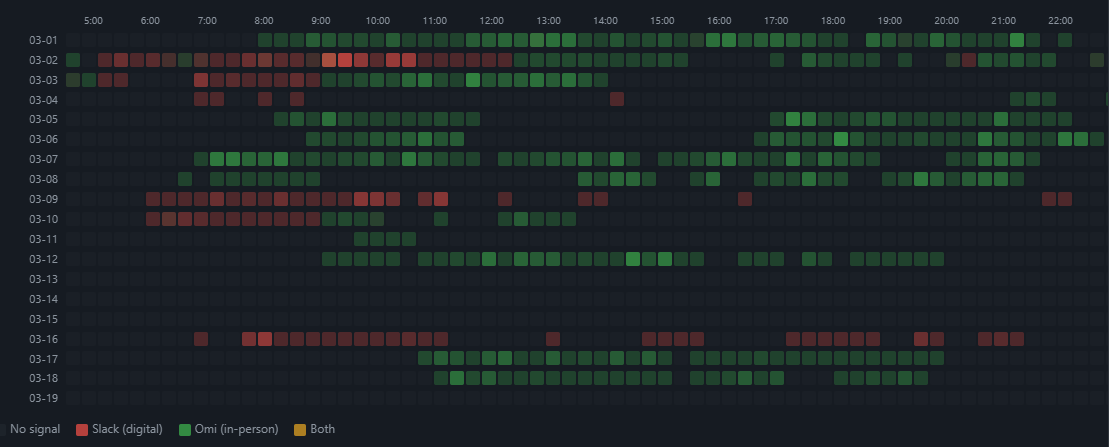
Two takeaways from this:
Maybe we need a better way to visualize this.
This chart clearly shows that the daily presence score is way too forgiving. I’m a lot less present than the DPS suggests.
How Alfred helps
The core idea is that I want to feed this into Alfred and a heartbeat should check these scores every 15 minutes. If I’m drifting, Alfred should be able to nudge me. A simple notification could work but I want the agent to actually look at what’s happening and give me valuable, context-aware feedback.
This feeds into the “use notifications as interruptions” strategy. I don’t have this set up yet properly but these would be the actuators we need for course correction. Can be a push notification (make me look at screens so bad) or a gentle “David, you’re drifting” nudge via an intercom device (invasive but better).
I also plugged in Alfred into our Home Assistant which unlocked a whole other ways of tracking my presence that I can’t wait to explore. It also highlighted the main challenges with hallucinations.
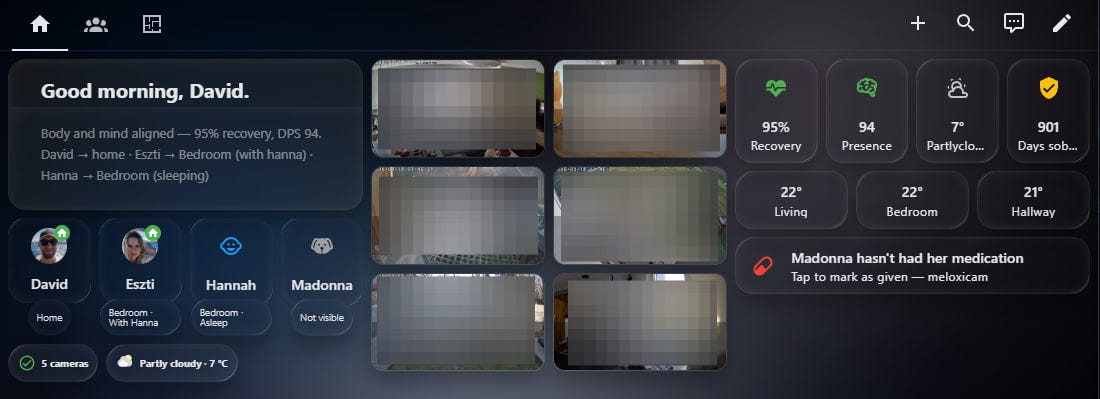
This became apparent when Alfred confidently reported that Hanna was BOTH sleeping in her room AND crying in the living room.
So I started working on a few updates to Alfred, introducing a World Model as a source of truth. This is still WIP but you can follow progress on the v1.0 branch.
Any updates on Alfred?